
Related reading
- Our Bamboo Removal service page, what we do and how the job runs
- Yucca Removal Cost in Australia, What Affects the Price
- Stump Grinding Cost in Wollongong & the Illawarra
- Tight Access Stump Removal, for stumps and clumps behind narrow gates
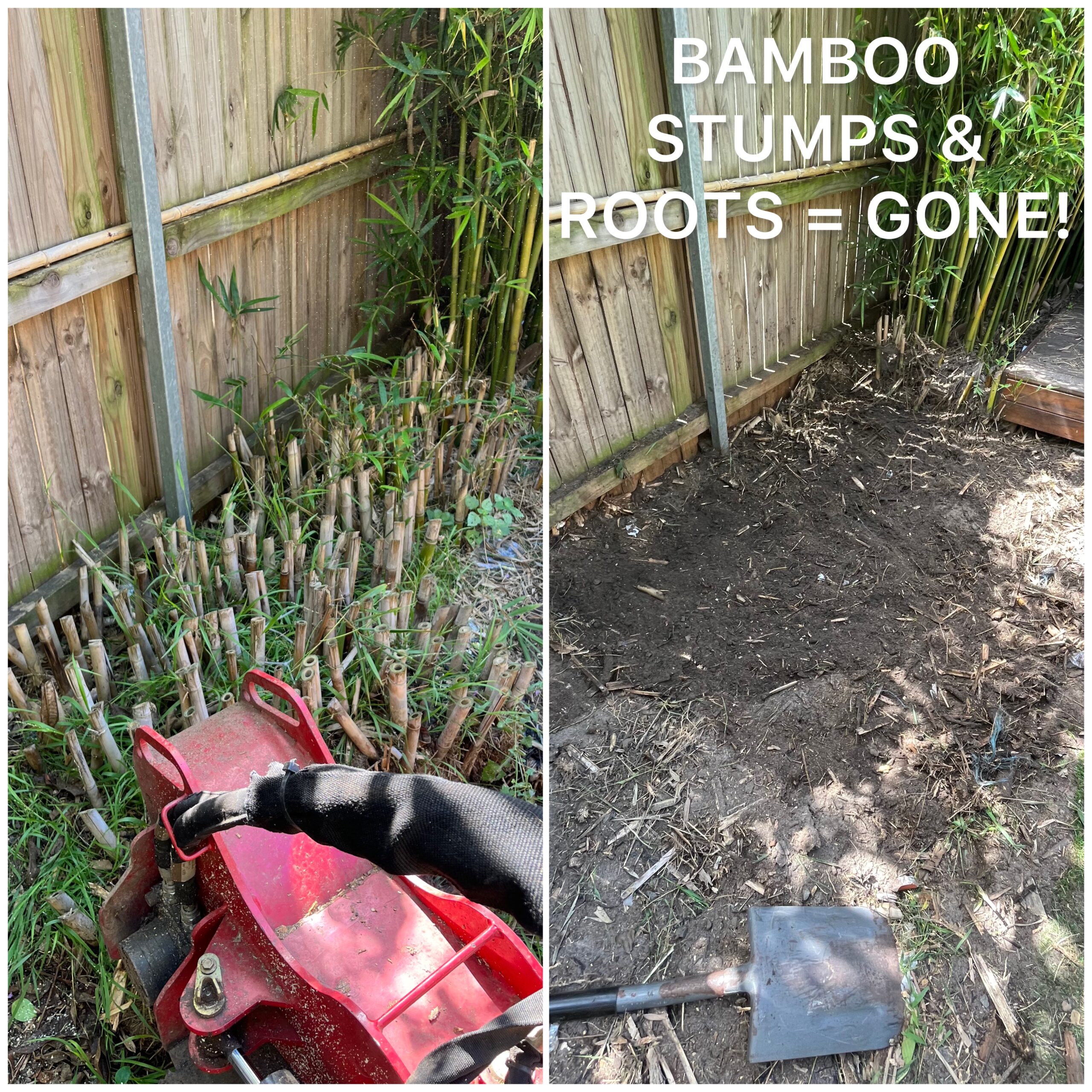
Bamboo removal is one of the most complex and labour intensive jobs in residential landscaping. What started as a neat privacy screen can become an aggressive infestation that cracks paths, lifts pavers, and pushes through your neighbour’s fence. If you are dealing with a bamboo problem, this guide explains what affects the removal cost, what the process involves, and why getting it done properly the first time matters more than the upfront price.
Why Bamboo Is So Hard to Stop
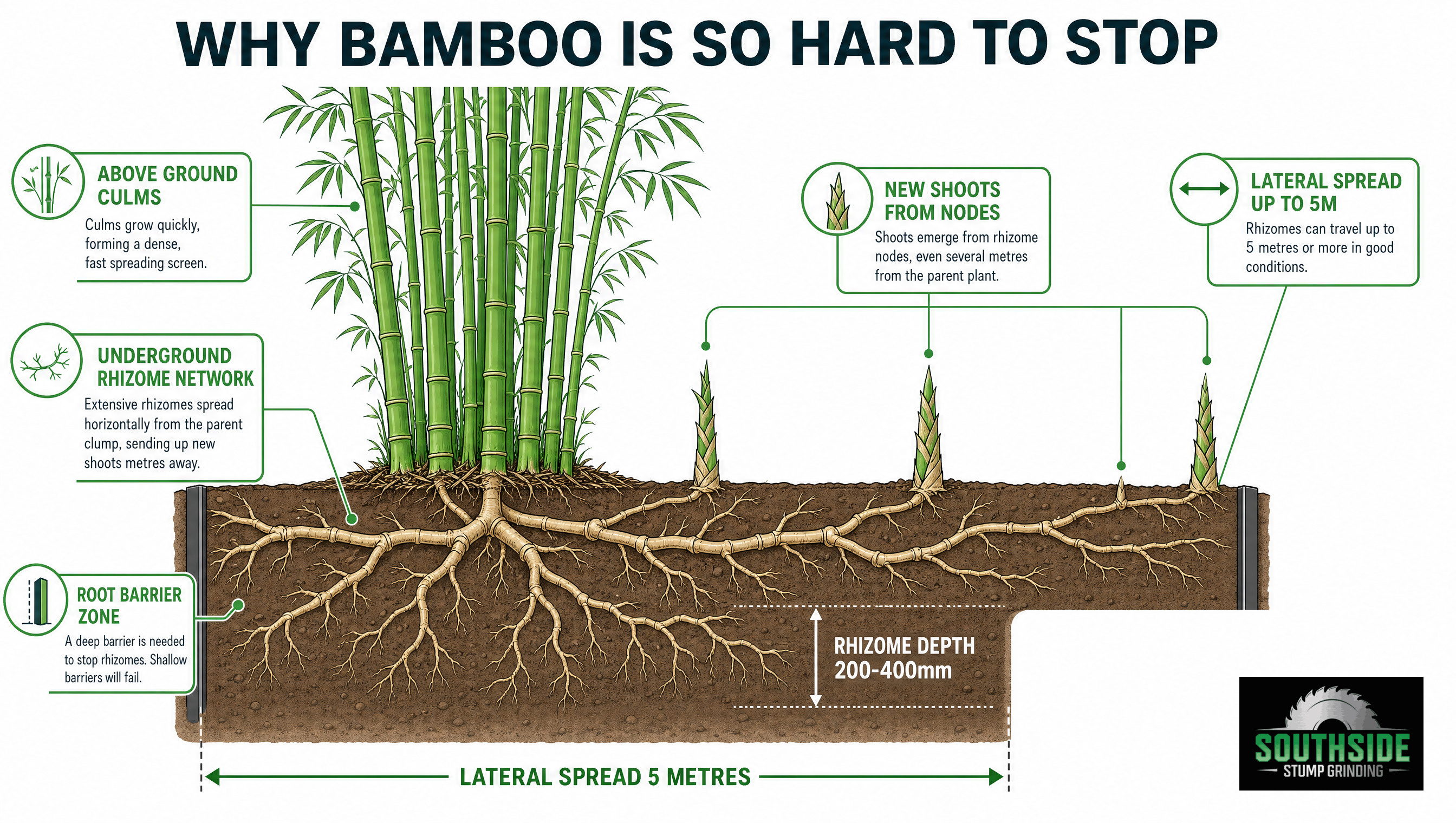
Most homeowners are surprised by bamboo removal pricing. The reason: the part above ground is just a fraction, like an iceberg, there is far more hidden below the surface.
Bamboo grows from an underground network of rhizomes. These thick, woody stems spread horizontally through the soil, sending up new shoots as they go. In running bamboo species, the rhizome network can extend 5 to 10 metres from the visible clump. That means the excavation zone is far larger than the bamboo you can see.
The rhizomes are tough. They grow through mortar joints, around pipe fittings, under concrete slabs, and across property boundaries. Removing them requires mechanical excavation, careful hand extraction near structures, and thorough inspection to ensure no fragments are left behind.
Even a single rhizome fragment as small as 50mm can produce a new shoot. Incomplete removal guarantees the bamboo comes back.
Running Bamboo vs Clumping Bamboo
The species type is the first thing a professional needs to establish. Running and clumping bamboo are completely different jobs with completely different methods.
Running Bamboo
Species like Golden Bamboo (Phyllostachys aurea), Black Bamboo (Phyllostachys nigra), and Arrow Bamboo (Pseudosasa japonica) spread via underground rhizomes that travel metres from the parent plant. They send up new shoots throughout your yard, under fences, through garden beds, and into neighbouring properties.
Running bamboo removal requires excavation of the entire rhizome network, not just the visible clump. This is the most labour intensive bamboo removal work, and it is the most involved.
Clumping Bamboo
Species like Bambusa and Dendrocalamus grow in a tight, slowly expanding clump. They do not send long distance runners. The root ball is contained within a 1 to 2 metre radius of the visible clump.
Clumping bamboo removal involves cutting the clump at ground level and excavating the root ball. It is a more contained job than running bamboo removal.
If you are unsure which type you have, look at the growth pattern. Running bamboo sends individual shoots popping up in random spots across your yard. Clumping bamboo grows in a dense mass that expands slowly outward from the centre.
“Highly recommend Luke and Southside Stump Grinding. Luke was professional, communication was excellent and he had my bamboo roots removed completely within a day. It was a tricky job that many other companies turned down. Price very reasonable too.”
Factors That Affect Bamboo Removal Cost
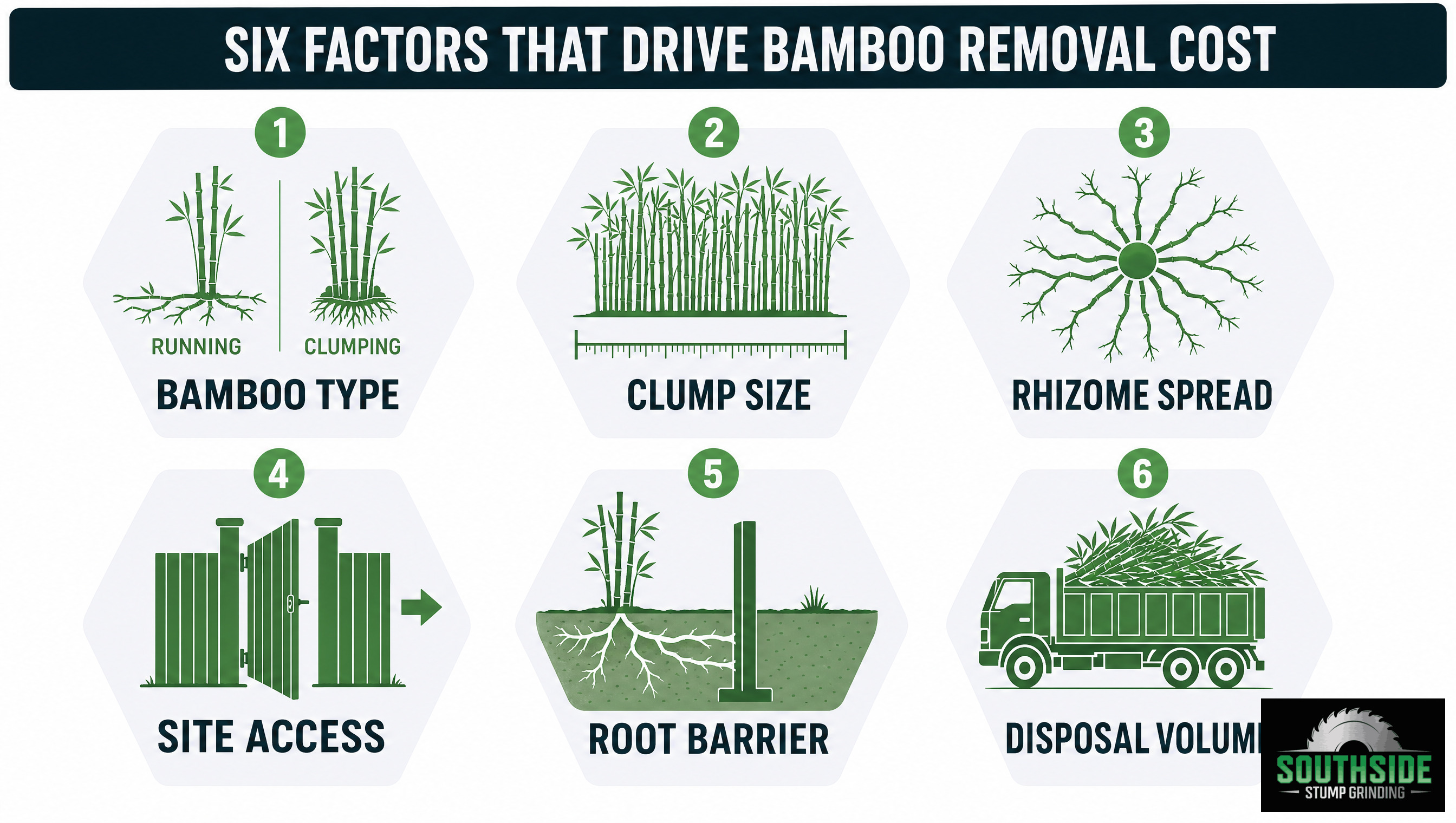
1. Species and Growth Habit
Running bamboo typically costs significantly more than clumping bamboo of a similar visible size. The underground work is where the time and cost accumulate.
2. Area of Infestation
Bamboo removal is measured in square metres. A small clumping bamboo might cover 2 to 3 square metres. A running bamboo infestation that has been growing unchecked for years can cover 20 to 50 square metres or more, including the underground rhizome spread that is not visible on the surface.
3. Rhizome Depth and Density
Bamboo rhizomes typically grow at 150 to 400mm below the surface, but in loose or sandy soils they can reach 600mm. The denser the rhizome network, the more excavation and hand sorting is needed. In clay soils common across the Illawarra, rhizomes tend to stay shallower but form tighter mats that are harder to extract cleanly.
4. Has It Spread to Neighbouring Properties?
If rhizomes have crossed your boundary fence, the removal zone expands. Coordination with your neighbour may be needed. In some cases, only the bamboo on your side can be removed, and a root barrier is installed along the boundary to prevent recontamination.
5. Access for Machinery
Most bamboo removal jobs require a mini excavator. Getting the machine to the bamboo location matters. Open front yard access is straightforward. Rear yard access through a narrow side gate, or bamboo growing on a steep slope, adds time. Some jobs require hand excavation in sections where machinery cannot reach.
6. Disposal Volume
Bamboo waste is bulky and heavy. A 20 square metre removal can produce 3 to 4 cubic metres of rhizome and cane material. All of it must be removed from site and disposed of at a licensed green waste facility. Bamboo should never be composted at home because rhizome fragments can survive and re-establish wherever the compost is spread.
Related service
Bamboo Removal across the Illawarra, Sutherland Shire and Southern Highlands
Canes down, rhizome network excavated, hand extraction near fences and structures, optional HDPE root barrier installation. No call out fees.
Can You Remove Bamboo Yourself?
A small clumping bamboo under 2 metres tall can be removed with a mattock, saw, and a solid day of physical work. Beyond that, DIY bamboo removal is rarely successful.
The most common DIY approach is chemical treatment. Homeowners cut the canes and apply glyphosate, hoping the bamboo will die off. This can work for clumping bamboo over 12 to 18 months with repeated applications. For running bamboo, chemical only treatment is unreliable. The rhizome network stores enough energy to survive multiple applications, and new shoots continue to appear from untreated sections of the network.
Homeowners who attempt physical removal of running bamboo typically spend multiple weekends digging and still miss rhizomes that regrow within months. The rhizomes interweave with other root systems, grow under paths and fences, and require a mini excavator to extract effectively across any area larger than a few square metres.
Professional mechanical removal is faster, more thorough, and ultimately less expensive than years of repeated DIY attempts.
“Luke and his team were fantastic in their removal of a huge amount of bamboo from our property in Towradgi. Luke’s communication and quote were excellent, and he made time for us very quickly after our initial site inspection. He and his team were respectful and prompt, worked quickly and left the backyard clean. Very happy!”
The Professional Bamboo Removal Process
Professional bamboo removal follows a proven sequence designed to get the entire plant out, rhizomes and all.
Root Barrier Installation
If the source bamboo is on a neighbouring property and complete removal is not possible, a root barrier prevents recontamination. The standard barrier is 600mm deep HDPE (high density polyethylene) sheeting installed vertically along the boundary line. This depth exceeds the typical rhizome growth zone and provides a long term physical block.
Root barriers can be installed at the same time as bamboo removal for efficiency.
Legal Considerations in NSW
Bamboo is not a protected species in any NSW council area. You do not need a permit to remove it from your property.
However, bamboo that crosses property boundaries creates legal issues. Under NSW common law and the Dividing Fences Act, you have the right to remove bamboo growth on your side of the boundary. You should notify your neighbour in writing before doing so.
Several NSW councils, including Wollongong City Council and Sutherland Shire Council, can issue orders requiring property owners to control bamboo that encroaches onto neighbouring land or public areas. If your neighbour’s bamboo is causing damage to your property, documenting the encroachment and contacting your council is a practical first step.
Some councils in the Shoalhaven and Illawarra actively discourage planting running bamboo varieties. If you are considering replacing removed bamboo with new plantings, opt for a clumping variety or choose an alternative screening plant entirely.
“Luke is very professional, extremely communicative, arrives on time, gets the job done and goes above and beyond. He was removing bamboo from my property and my neighbours, and there were some tricky areas that he handled with grace. Would recommend Luke and Southside Stump Grinding to anyone in need of garden support.”
How Long Does Bamboo Removal Take?
- Small clumping bamboo: Half a day
- Moderate running bamboo (10 to 20 sqm): 1 to 2 full days
- Large running bamboo infestation (50 plus sqm): 3 to 5 days
The removal timeline also depends on disposal logistics. Large jobs produce significant waste volumes that require multiple truck loads to the tip.
Frequently Asked Questions
How do I tell if my bamboo is running or clumping?
Look at the growth pattern. Running bamboo sends individual shoots popping up in random spots across your yard, often metres from the main clump, under fences and through garden beds. Clumping bamboo grows in a dense mass that expands slowly outward from the centre. Common running species in NSW include Golden Bamboo (Phyllostachys aurea) and Black Bamboo. Common clumping species are Bambusa and Dendrocalamus. If unsure, take a wide shot of the area and a close up of the canes and send them through, we can identify the species before the inspection.
Will the bamboo grow back?
Not if the rhizome network is fully extracted and the inspection step picks up any remaining fragments. The risk is greater for running bamboo because the rhizome reach extends 5 to 10 metres from the visible clump and even a 50mm fragment can produce a new shoot. The professional process covers this with mechanical excavation, hand extraction near structures, herbicide treatment of the exposed soil, and a 6 to 12 month monitoring window where any new shoots are cut and treated immediately.
Can you install a root barrier between my property and the neighbour’s bamboo?
Yes. The standard is 600mm deep HDPE (high density polyethylene) sheeting installed vertically along the boundary line. We dig a trench along the boundary, drop the HDPE sheet in, and backfill. The 600mm depth exceeds the typical rhizome growth zone and gives a long term physical block. Root barriers can be installed at the same time as bamboo removal, which is more efficient than two separate visits.
What happens to all the bamboo waste?
All cane and rhizome material is loaded into the truck and taken to a licensed green waste facility. Bamboo waste cannot be composted at home, because rhizome fragments survive composting and re-establish wherever the compost is spread. Disposal is included in the quote.
Do I need to tell my neighbour before bamboo work?
If the bamboo is purely on your side of the boundary, no. If the rhizomes have crossed onto your side from the neighbour’s bamboo, you have the right under NSW common law to remove the growth on your side, but you should notify your neighbour in writing first. We can talk you through the process if it applies to your job.
How do I get an accurate bamboo removal quote?
Bamboo removal cannot be accurately quoted from photos alone, the underground rhizome spread is not visible from the surface. A free on site assessment takes 15 to 20 minutes and gives you an accurate, no obligation quote for the full job. Send a wide shot and a close up of the canes ahead of time so we can identify the species before the inspection.
How You Get Your Yard Back
Getting a bamboo infestation out of an Illawarra, Sutherland or Highlands backyard does not have to be complicated. At Southside Stump Grinding we get the rhizome network out properly the first time, and we leave the area ready to plant or pave straight away.
No pushy sales tactics. Luke comes around for a friendly look at the bamboo, walks through what the job involves, identifies the species, and gives you a straight fixed price quote on the spot. You decide whether you want to go ahead in your own time. People choose us because we tell them exactly what they are paying for and we do not leave rhizomes behind for the bamboo to grow back from.
We walk you through what equipment we will use, how we will get the excavator in and out, where the waste will go, how the boundary will be protected with a root barrier if needed, and how the site will be left. We will flag anything we notice about neighbours, structures or pipes that affects the job.
Our goal is straightforward. Bamboo gone, rhizome network out, area ready for whatever you are planning next, no recontamination from the neighbour’s side, and no surprises on the invoice.
Get in touch with us today. We will come out, look at the job, identify the species, and give you a no obligation quote so you know exactly what to expect.
How We Work With You
Our process is straightforward and designed around your needs.
Step 1: We Talk and Answer Your Questions
When you get in touch, Luke will call you back or reach out to organise a time to come look at the bamboo. We explain who we are, how we work, and exactly how the job will run on the day. We answer any questions about species identification, neighbour coordination, root barriers, or timing.
Step 2: We Quote on Site
Luke comes to the property, identifies the bamboo species, assesses the infestation zone, checks access, and writes a fixed price quote on the spot. 15 to 20 minutes. No call out fee, no obligation.
Step 3: You Decide What Works Best
You take the quote and decide in your own time. If you want to go ahead, we book you in at a time that suits. If you want to get a second quote first, that is fine, we will not chase you.
Step 4: We Do the Job Properly
Crew arrives on the booked day, canes cut and cleared, rhizome network excavated, hand extraction near structures, exposed zone inspected and treated, soil backfilled, optional root barrier installed along the boundary if needed. All waste loaded and taken to a licensed green waste facility. We do not leave until you are happy with how it looks.
Get a Free Bamboo Removal Quote
Bamboo removal cannot be accurately quoted from photos alone. The underground rhizome spread is not visible from the surface, and the species type dramatically affects the scope of work. A free on site assessment takes 15 to 20 minutes and gives you an accurate, no obligation quote for the full job.
I service the Wollongong & Illawarra, the Sutherland Shire & Southern Sydney, and the Southern Highlands. Call the number closest to you:
Speak with us today
- Wollongong & Illawarra: 0413 655 655
- Sutherland Shire & Southern Sydney: 0466 977 222
- Southern Highlands: 0414 592 060
- Or get in touch online: southsidestumpgrinding.com.au/contact
Sources
- NSW Department of Primary Industries, weeds and invasive plant management
- Wollongong City Council, vegetation and boundary management
- Sutherland Shire Council, vegetation and boundary management
- NSW Dividing Fences Act 1991, boundary growth and removal rights
- Before You Dig Australia (BYDA), underground service location service
- Arboriculture Australia, industry standards
- Safe Work Australia, ground penetration and powered tool safety
Regulations around weed management, council vegetation rules and boundary growth change from time to time. Linked content may be updated or move. Please get in touch if you would like the most current advice for your job.
You might also need: Yucca Removal Cost in Australia: What Affects the Price
Our service: Bamboo Removal Services | Southside Stump Grinding Home