Related reading
- Small Tree Removal, our service page for residential trees up to 6 metres
- Palm Removal, Cocos, Alexandra and Phoenix palms across the Illawarra
- Tight Access Stump Removal, for stumps behind narrow side gates
- Stump Grinding Cost in Wollongong & the Illawarra
Whether it is a dead gum tree threatening your roof, a palm that has outgrown its spot, or a damaged tree left behind by a storm, there are plenty of reasons Wollongong homeowners need tree removal. But before you book anyone, you need to understand the council rules, what different services actually cover, and what happens to the stump once the tree is gone.
This guide covers everything a Wollongong homeowner needs to know about tree removal, from council permits to the final stump grind.
When Do You Need Tree Removal?
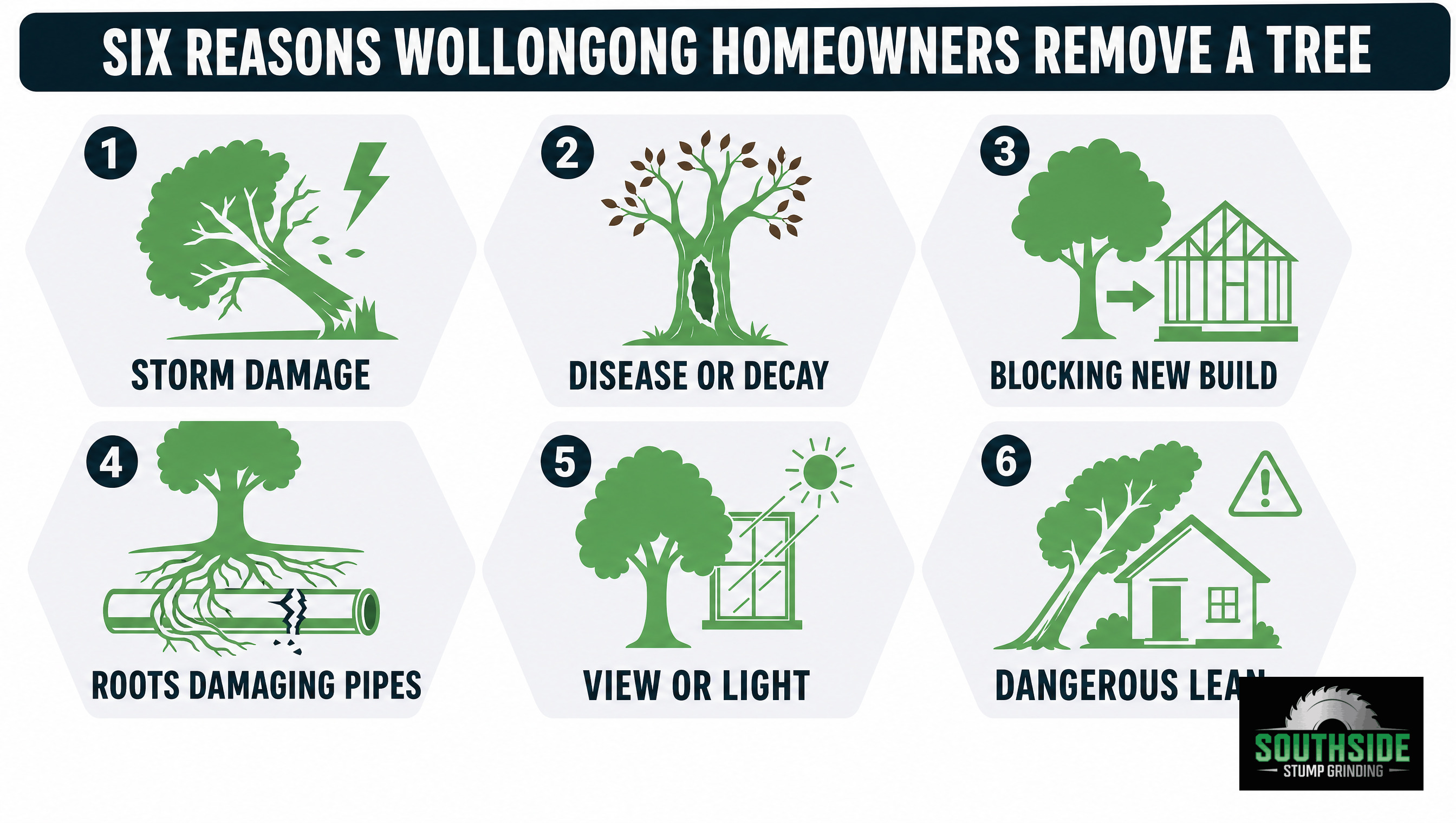
Most tree removals in the Illawarra fall into one of these categories:
- Dead or dying trees. A dead tree is a falling hazard, especially during the storms and strong winds that hit the Illawarra coast. Dead branches can drop without warning, damaging roofs, cars, fences, and anyone below.
- Storm damage. Wollongong gets its share of east coast lows and severe weather events. Partially uprooted or split trees need professional assessment and removal.
- Dangerous lean. A tree leaning toward a house, power lines, or a neighbour’s property needs attention before it becomes an emergency.
- Building works. Renovations, extensions, pool installations, and new driveways often require trees to be removed from the build zone.
- Overgrown or poorly positioned trees. Trees planted too close to houses, fences, or drains can cause root damage, block light, and crowd neighbouring properties.
- Pest species. Some trees like camphor laurel are classified as environmental weeds in the Illawarra and can be removed under council exemptions.
“Luke ground out 7 stumps on our property in Thirroul. He was easy to contact, came the next day, co-ordinated our job with a council job on our front nature strip, was thorough, friendly and professional, and also recommended someone who could mulch for us. Wouldn’t hesitate to recommend and would definitely contact him again if we needed more work done.”
Wollongong City Council Tree Removal Rules
You cannot remove most trees in Wollongong without council approval. Wollongong City Council has a Tree Management Policy that protects trees on private land.
When You Need a Permit
You generally need approval to remove a tree if it meets any of these thresholds:
- Over 3 metres tall
- Trunk circumference over 500mm measured at 1 metre above ground level
- Listed as a significant or heritage tree
Approval is applied for through Wollongong City Council’s development services. The application requires details about the tree species, size, condition, and your reason for wanting it removed. Processing times vary, but allow several weeks.
When You Do Not Need a Permit
Some removals are exempt from the permit process:
- Dead trees (no living foliage remaining)
- Declared pest species such as camphor laurel, privet, and rubber tree
- Trees posing an immediate threat to life or property (emergency removal, but you must notify council afterwards)
- Trees under the size thresholds listed above
Rules change, so check directly with Wollongong City Council before removing any tree. Penalties for unauthorised tree removal in NSW can be substantial.
Stump Grinding Does Not Require a Permit
Once a tree has been legally removed, grinding the remaining stump is classified as garden maintenance. No council approval is needed for stump grinding anywhere in NSW.
Small Tree Removal vs Large Tree Removal
Not every tree removal job requires a crane and a crew of five. The approach depends on the tree’s size, location, and risk profile.
Small Trees (Up to Approximately 6 Metres)
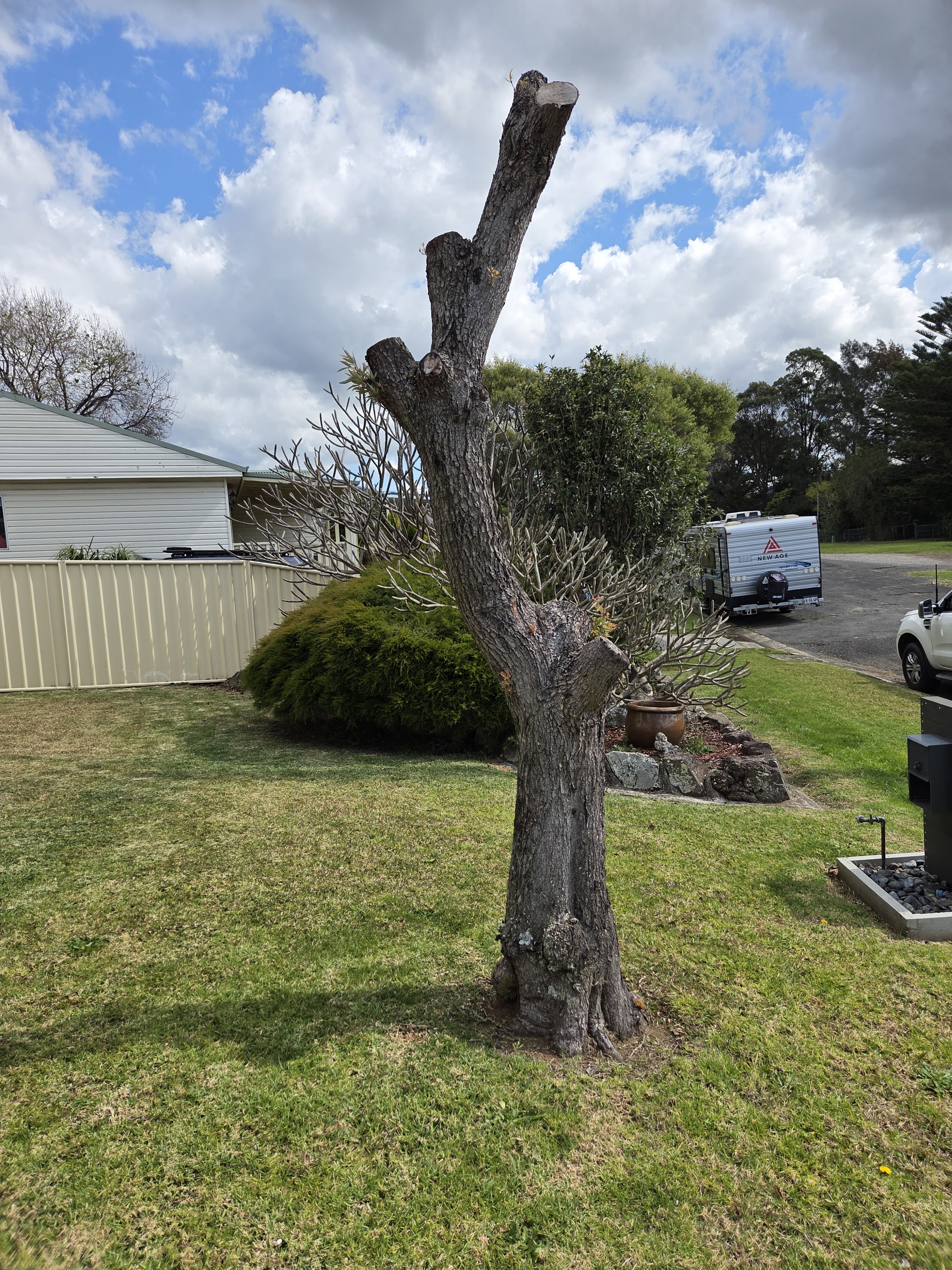
Most backyard trees fall into this category. Fruit trees, ornamental trees, small to medium eucalyptus, and overgrown shrubs like bottlebrush and grevillea can be removed using chainsaws, hand tools, and rigging techniques. No heavy machinery is needed.
Southside Stump Grinding handles small tree removal for trees up to approximately 6 metres tall and 300mm trunk diameter. This covers the majority of suburban backyard trees across Wollongong, Figtree, Corrimal, Dapto, and the surrounding suburbs.
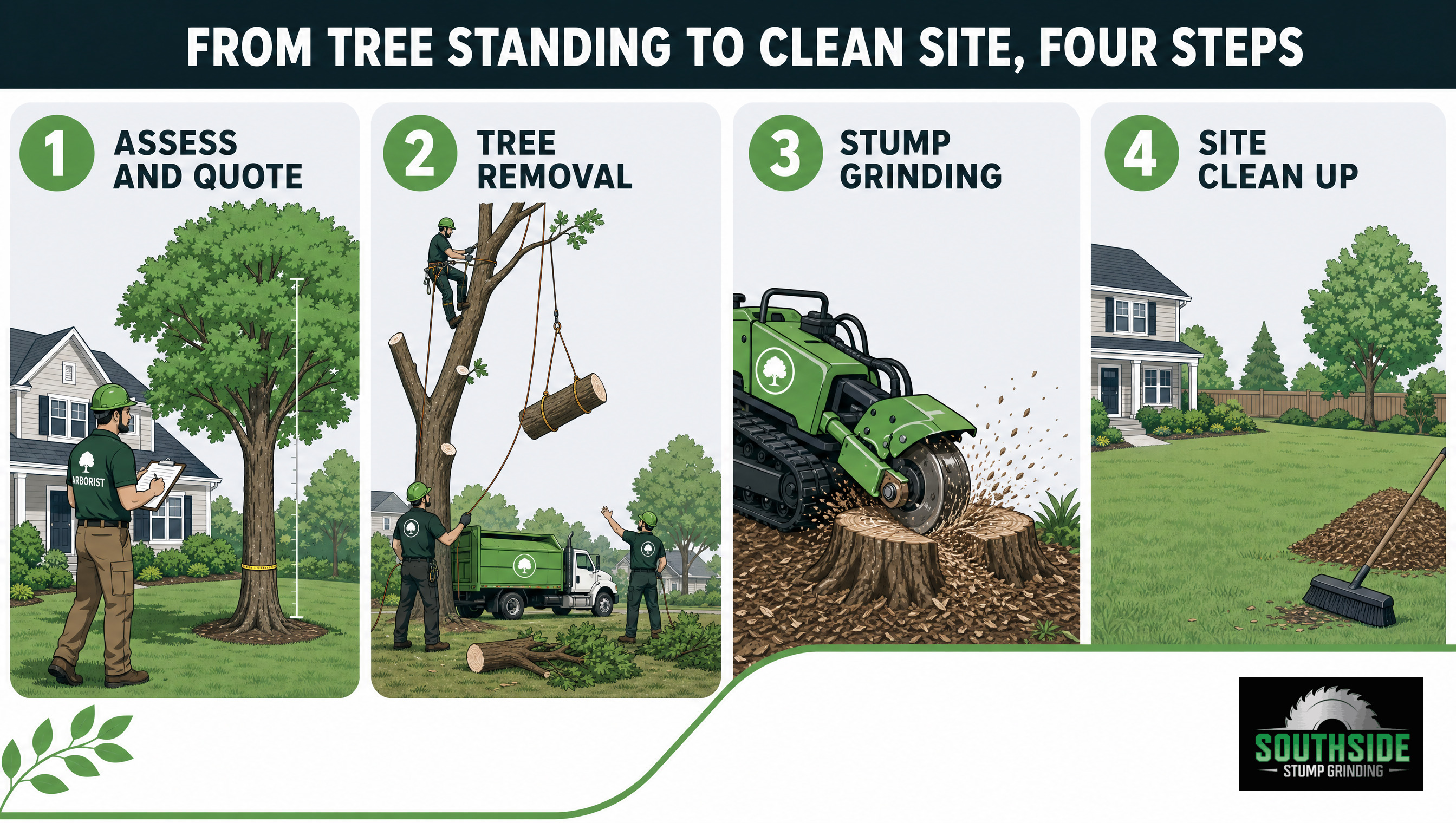
Trees are typically removed using sectional dismantling, where the tree is taken apart from the top down in controlled pieces. This is the standard method for residential areas where trees are close to houses, fences, power lines, or other structures.
Large Trees (Over 6 Metres or High Risk)
Trees taller than 6 metres, trees overhanging structures, or trees requiring elevated work platforms or cranes need a specialist arborist. This is a different type of operator with different equipment, insurance, and qualifications.
If your tree is too large for Southside to handle, Luke will tell you during the quoting visit and can point you toward a qualified arborist in the Illawarra.
The Job from Quote to Clean Site
Palm Tree Removal in Wollongong
The Illawarra’s mild, subtropical climate means palms are everywhere. Cocos palms, Alexandra palms, Phoenix palms, Bangalow palms, and various other species line driveways, dot backyards, and crowd boundary fences across the region.
Common Palm Removal Jobs
- Cocos palms are one of the most common removal requests. They grow tall, drop heavy fronds and fruit clusters, and are classified as an environmental weed in parts of NSW because their fruit spreads into bushland.
- Alexandra palms grow in clusters and can crowd garden beds and pathways as they mature.
- Phoenix palms (Canary Island date palms) develop thick, heavy trunks and sharp frond bases. They are imposing trees that outgrow most residential settings.
Palm removal involves cutting the trunk in sections from the top down. Palm timber is fibrous and soft compared to hardwood, but the trunk sections are heavy and need to be lowered carefully in residential settings.
Palm Stumps
Palm stumps do not regrow, so stump grinding is not strictly necessary to prevent regrowth. However, palm stumps left in the ground decompose very slowly and attract insects, including cockroaches and termites that nest in the soft, moist trunk tissue. A protruding palm stump is also a trip hazard and a mowing obstacle.
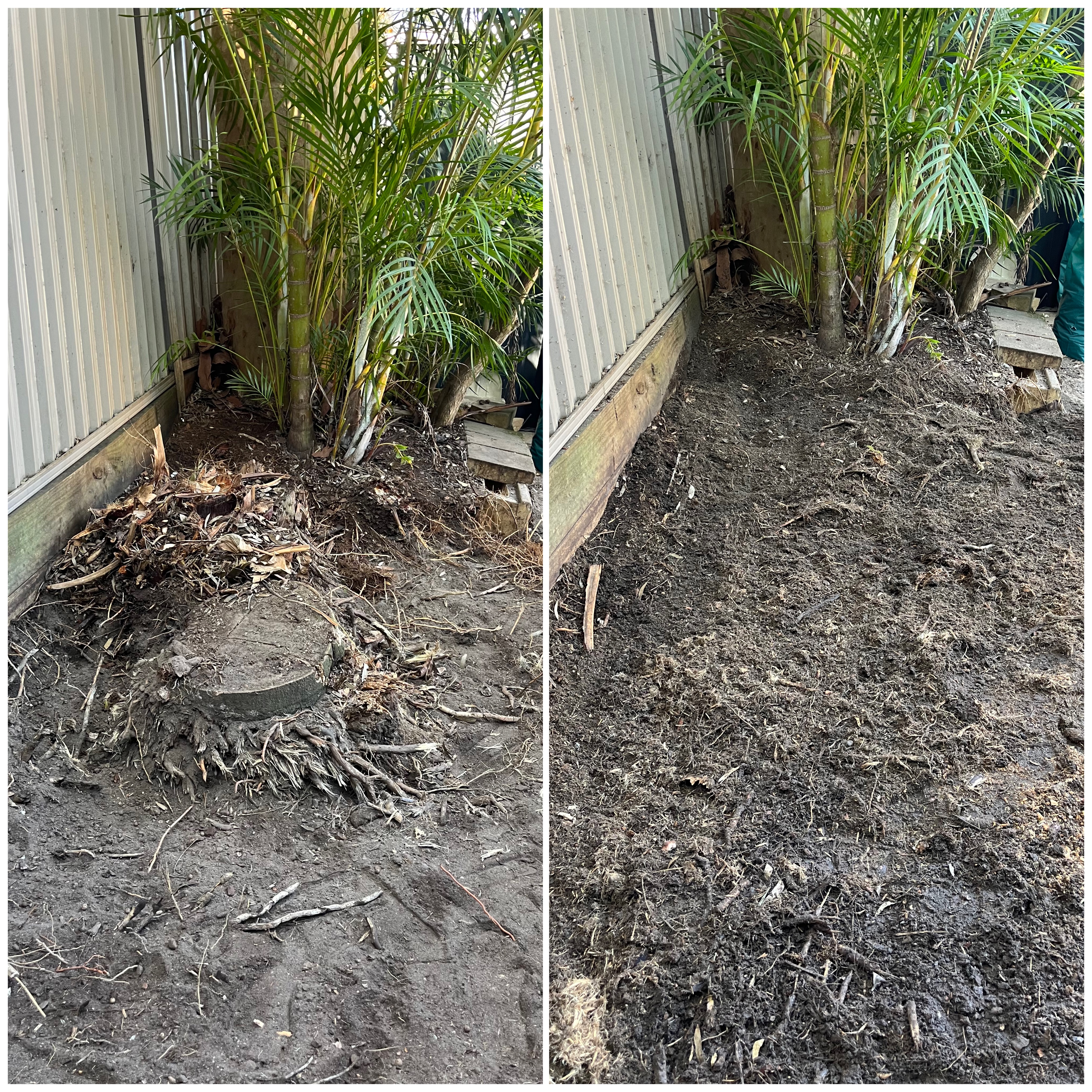
Most homeowners choose to have the palm stump ground below soil level so the area can be turfed or landscaped. Palm stumps are softer than hardwood and grind quickly. A standard Cocos palm stump takes 15 to 30 minutes to grind.
Related service
Small Tree Removal across Wollongong & the Illawarra
Trees up to about 6 metres, sectional dismantling from the top down, all waste removed and stump grinding bundled if you want it.
What Happens After Tree Removal, Stump Grinding
Tree removal companies often leave the stump behind. They cut the tree down, chip the branches, load the trunk, and drive away. You are left with a stump sticking out of the ground.
A stump left in the ground:
- Attracts termites and other pests
- Is a trip hazard for children and visitors
- Prevents you from turfing, paving, or planting in that area
- Can produce sucker growth in some species (coral trees, poplars, some eucalyptus)
- Looks unsightly and reduces property appeal
Stump grinding uses a specialised machine with a rotating carbide-tipped wheel to chip the stump and surface roots into mulch, typically 150-250mm below soil level. The process is fast, controlled, and far less disruptive than digging the stump out.
If the stump is in a tight spot behind a house with narrow side access, tight access stump grinding equipment can fit through gates as narrow as 700mm.
“I’m in the Wollongong suburb of Lake Heights. I called Luke the other day regarding only one stump on my property that needed removal. He arrived this morning, on time and was able to fit me in straight away. Great service, great price and Luke was great to deal with. I highly recommend Southside Stump Grinding to anyone.”
Common Tree Species in the Wollongong Area
The Illawarra has a diverse mix of native and introduced tree species. The most common species Southside removes and grinds include:
- Eucalyptus (spotted gum, ironbark, turpentine, blackbutt), dense hardwoods that take longer to grind
- Camphor laurel, an environmental weed, softer timber, grinds quickly
- Liquidambar, common in older suburbs, medium difficulty
- Jacaranda, soft timber, straightforward removal
- Norfolk Island pine, large specimens that often outgrow residential blocks
- Fig, extensive surface root systems that add significant scope to stump grinding
- Coral tree, soft timber but produces aggressive sucker growth from roots
- Cocos palm, Alexandra palm, Bangalow palm, fibrous trunks, fast grinding
Frequently Asked Questions
Do I need a permit to remove a tree in Wollongong?
Yes if the tree is over 3 metres tall, has a trunk circumference over 500mm at 1 metre above ground level, or is listed as a significant or heritage tree. You do not need a permit for dead trees, declared pest species like camphor laurel and privet, or trees posing immediate threat. Rules change, check with Wollongong City Council before booking removal.
Can you remove the tree AND grind the stump in one visit?
Yes. Small tree removal and stump grinding are usually bundled into one job for trees up to 6 metres. The tree comes down in sections, branches get chipped, trunk gets loaded, and the stump is ground to 150 to 250mm below ground level in the same visit. Site is left ready for topsoil, turf or planting.
What is the difference between tree removal and stump grinding?
Tree removal takes the tree down. The trunk and branches come off, get cut into transportable sections, and either get chipped on site or loaded and hauled away. Stump grinding is the next step, the stump that is left in the ground after the tree comes down gets ground to mulch and reduced below soil level. Most tree removal companies do not grind the stump and leave it for you to deal with. We do both.
Do palm stumps need grinding?
Not strictly, palms do not regrow from the stump. But left in the ground a palm stump decomposes very slowly, attracts termites and cockroaches that nest in the soft trunk tissue, and is a trip hazard. Most homeowners get the palm stump ground out as part of the removal so the area can be turfed or planted. Palm stumps grind quickly because the timber is soft and fibrous, typically 15 to 30 minutes for a Cocos.
How tall a tree will you take down?
Up to approximately 6 metres tall and 300mm trunk diameter. That covers the majority of backyard trees across Wollongong, Figtree, Corrimal, Dapto and the surrounding suburbs. Anything bigger than that, or anything overhanging a house or near power lines, needs a specialist arborist with cranes and elevated work platforms. We will tell you on the quote visit if the tree is outside our scope, and we can point you to a trusted arborist in the Illawarra.
What about emergency tree removal after a storm?
If a tree has come down or is at imminent risk of coming down on a structure, contact us and we will see how quickly we can get there. Where life or property is at immediate risk, council has provisions for emergency removal without prior approval, but you do need to notify them afterwards. For non-urgent storm damage the standard quote process applies.
How You Get the Tree Out
Getting a tree out of a Wollongong backyard does not have to be complicated. At Southside Stump Grinding we run the whole job, from quote to clean site, and we leave the area ready to turf or plant straight away.
No pushy sales tactics. Luke comes around for a friendly look at the tree, walks through what the job involves, and gives you a straight fixed price quote on the spot. You decide whether you want to go ahead in your own time. People choose us because we tell them exactly what they are paying for and we do not leave a stump behind for someone else to deal with.
We walk you through whether the tree is in scope for us or needs an arborist, what the council position is for your species and size, how we will get the tree out and the stump down, where the waste will go, and how the site will be left. We will flag anything we notice about access, structures or nearby plants that affects the job.
Our goal is straightforward. Tree gone, stump ground out, area ready for whatever you are planning next, no damage to fences or pavers, and no surprises on the invoice.
Get in touch with us today. We will come out, look at the job, and give you a no obligation quote so you know exactly what to expect.
How We Work With You
Our process is straightforward and designed around your needs.
Step 1: We Talk and Answer Your Questions
When you get in touch, Luke will call you back or reach out to organise a time to come look at the tree. We explain who we are, how we work, whether the tree is in scope for us, and exactly how the job will run on the day. We answer any questions you have about council rules, depth of cut, mulch, access, or the timing.
Step 2: We Quote on Site
Luke comes to the property, walks the job, identifies the species, checks access, and writes a fixed price quote on the spot. 10 to 15 minutes. No call out fee, no obligation.
Step 3: You Decide What Works Best
You take the quote and decide in your own time. If you want to go ahead, we book you in at a time that suits. If you want to get a second quote first, that is fine, we will not chase you.
Step 4: We Do the Job Properly
Crew arrives on the booked day, tree comes down in sections, branches chipped, trunk loaded, stump ground to depth, surface roots followed, mulch backfilled or hauled away depending on what you chose. Site swept and tidied. We do not leave until you are happy with how it looks.
Get a Free Quote for Tree Removal in Wollongong
If you have a tree that needs removing or an old stump that a previous company left behind, the first step is a free on-site assessment. Luke will assess the tree, check access, identify any council considerations, and give you a clear, written quote.
I service the Wollongong & Illawarra, the Sutherland Shire & Southern Sydney, and the Southern Highlands. Call the number closest to you:
Speak with us today
- Wollongong & Illawarra: 0413 655 655
- Sutherland Shire & Southern Sydney: 0466 977 222
- Southern Highlands: 0414 592 060
- Or get in touch online: southsidestumpgrinding.com.au/contact
Southside Stump Grinding services Wollongong, Figtree, Corrimal, Dapto, Shellharbour, Kiama, and all suburbs across the Illawarra. Small tree removal, palm removal, and tight access stump grinding, from quote to clean site.
“HORSLEY/DAPTO AREA, 3 x TREE STUMP GRINDING after trees removed, Luke had great comms, quick on-site quote, easy to deal with, on time, fast and efficient, reasonable, fantastic job, I’m super happy with results. Thank you Luke. HIGHLY RECOMMEND.”
Sources
- Wollongong City Council, trees on private property and Tree Management Policy
- Arboriculture Australia, industry standards for tree work
- Standards Australia, AS 4373 Pruning of amenity trees
- NSW Department of Primary Industries, environmental weeds including camphor laurel and Cocos palm
- Before You Dig Australia (BYDA), underground service location service
- Vermeer Australia, professional stump grinder manufacturer
- Alpine Magnum, tight access stump grinder manufacturer
Council rules, weed declarations and tree management policies change from time to time. Linked content may be updated or move. Please get in touch if you would like the most current advice for your job.
You might also need: Stump Grinding Cost in Bowral & the Southern Highlands
Our service: Tree & Palm Removal Services | Southside Stump Grinding Home